
Trainer Talk {iQniter Series}: Your Heart on Exercise
By alexandra bonetti | May 16, 2013, 7:46 am
the-body
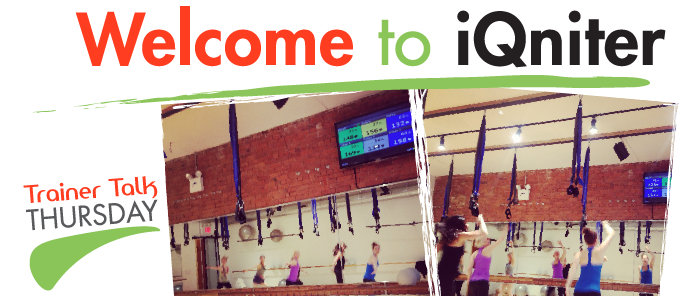
There are countless reasons why we’re excited about our new, cutting-edge heart rate training system, iQniter, but at the top of the list is the fact that this technology will push us to become better athletes. We’re nerds, so talking about heart rates, training zones, aerobic versus anaerobic states and exercise “after burn” feels like our second language. Since we’re assuming most of you don’t speak workout-ese, we’re embarking on a series of blog posts that will bring you up to speed and coach you on your iQniter training journey.
You might buy an iQniter heart rate belt and watch your rate on the screen for fun. Or maybe you just like the rush of it. Or you’re a numbers geek, and you love putting a number to your workout. All of the above is okay with us.
But perhaps you also want to understand those numbers and how to improve them. If so, this blog series is for you. If you have a specific question, please email us so we can respond to you via our blog so everyone else can learn.
Today, let’s start at the beginning and dig into the basics.
What does exercise do to the heart and why should we monitor our heart rate?
Your heart is a muscle that pumps blood to the rest of your body. When you exercise, the muscles you are working throughout your body need more blood, and they call on the heart to meet their increased demand. Like any pump, there are two ways for the heart to send more blood: to pump faster or to increase the size of its pump. The more intensely your body exercises, the more blood your muscles need to function, and so your heart has to pump faster. That’s why your heart rate increases. Just like any muscle in your body, your heart conditions itself the more you use it - so with time it becomes more efficient at sending blood to the rest of your muscles, and that “pump” gets bigger so it doesn’t need to pump as fast.
The first time you did Bari you might have felt like you were running out of breath during the first or second song; now you likely don’t notice your breath as much and you feel like you have more endurance. That’s because you’ve created a healthier heart, which means you improved your fitness level.
RHR - Resting Heart Rate - is your heart rate while fully relaxed and sitting or laying down. RHR is a good indicator of changes in cardiovascular fitness level. If your RHR decreases over a period of time, that means your heart is functioning more efficiently and is healthier. Athletes’ RHR is between 40 and 60, while sedentary people’s RHR is usually between 60 - 80. However, other factors, like heredity, affect your heart health, so it’s not the only measurement you should look at for heart health. For example, Jim Ryun is said to have had an RHR in the low 70s even while he was one of the greatest milers in US history.
MHR - Maximum Heart Rate - is the highest number of beats per minute for your heart. MHR is specific to what sport you are practicing. If you are a triathlete, for example, your MHR while you’re running will be much higher than when you’re swimming, because MHR takes into account muscle mass being used in the movement you’re performing, horizontal and vertical body positions, as well as gravity and buoyancy. So your heart rate at Bari will be different than the one used when running or spinning because at Bari you’re employing multiple muscles at all times. You’re twisting and turning instead of going up a hill in forward motion. This is very important to understand so you can take full advantage of every workout. It will also be different between a DRIP, a BOUNCE, a MACRO or a MICRO. Your iQniter equipment will figure out your MHR for you, but a formula I like to use is MHR = 205.8 - 0.685 x age.
MHR is not correlated to your fitness level. The amount of work you can do in a specific heart rate is. In fact, it’s not recommended to work above 85% (give or take, depending on the person) of your MHR because the risk for injury greatly increases while the added benefit is really marginal.
RHRD - Recovery Heart Rate Differential - is the difference you get when you subtract your heart rate at 1 minute after you stopped exercising from your heart rate right when you stopped exerting yourself. RHRD increases as your fitness improves and may be a great indicator of cardiac health as well.
Why does your heart rate differ in class from one day to another? There are many factors that can affect your heart rate from one minute to the next:
- Cardiac drift
- Rest and diet
- Body temperature or dehydration
- Gravity (BariBOUNCE!) and altitude
- Body position; you’ll notice as soon as you do planks or lay on your back to do abs, your heart rate will lower.
- Heat, humidity
- Equipment or if you’re holding on to extra weight
- Caffeine, drugs and medications
- Emotion, anxiety or nervousness
- Age and gender differences
- Time of day
Heart rate from maximal to recovery is specific to each sport. You cannot expect to know your heart rate in one sport because you know it in another. And in Bari, it goes even further, because it differs by class. Next week we’ll look at Bari’s specific classes and what you should be looking for on the screen in each class.